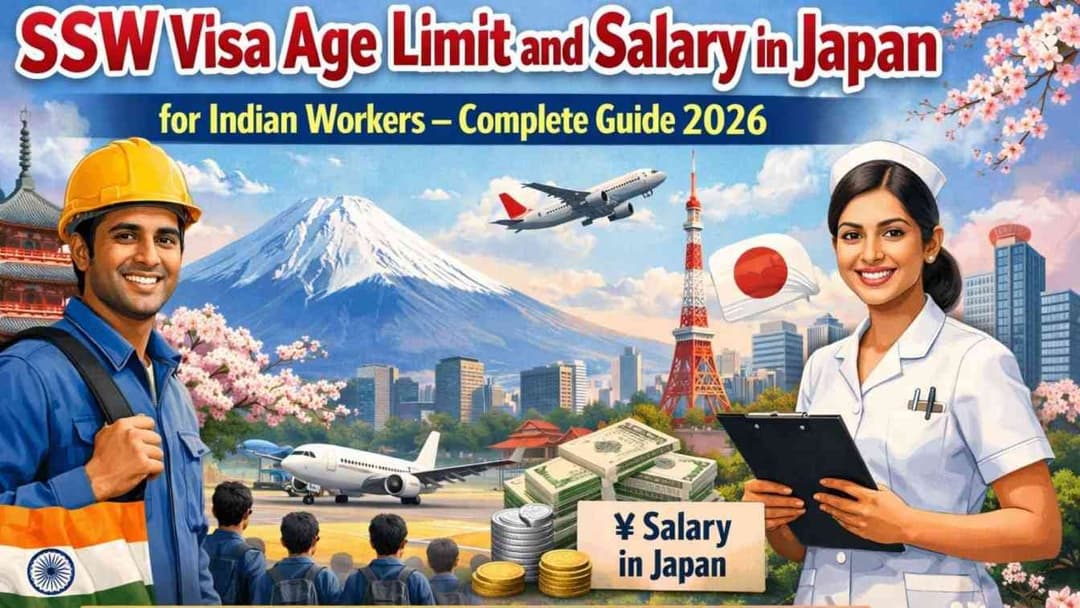
SSW Visa Age Limit and Salary in Japan for Indian Workers – Complete Guide 2026
Enroll Now
Published: 2026-01-09 06:17:54
Japan is facing a serious workforce shortage, especially in industries like caregiving, food services, construction, and manufacturing. To solve this, the Japanese government introduced the Specified Skilled Worker (SSW) visa program, offering foreign workers including Indians a structured pathway to work legally in Japan.
This guide explains the SSW visa age limit, salary expectations, eligibility, and application tips for Indian workers, along with how learning the Japanese language plays a vital role in success.
What is the SSW Visa Program?
The Specified Skilled Worker (SSW) visa is a Japanese government initiative designed to attract skilled foreign professionals into industries experiencing serious labor shortages. It allows qualified foreign nationals, including Indian workers, to live and work legally in Japan in 16 officially approved sectors such as caregiving, construction, food services, manufacturing, and hospitality.
The program not only supports Japan’s economy but also gives international workers a chance to build a stable career in a highly developed and well-organized work environment.
For detailed test dates and important SSW timelines, check our SSW Exam Schedule page for the latest updates.
Key Highlights of the SSW Visa
- Work legally in Japan for up to 5 years, gaining international work experience and income.
- Open across 16 skill-based industries where Japan actively recruits overseas talent.
- Requires passing a skill proficiency test and a basic Japanese language test (JLPT N4 or equivalent).
- No family reunification during the SSW period, keeping the focus on professional employment.
- Renewable annually, based on continued employment and compliance with visa rules.
In simple terms, the SSW visa is Japan’s official gateway for skilled foreign workers to enter the Japanese workforce legally, securely, and with long-term career potential.
If you want expert help with your application, you can start with professional Japan Visa Assistance to understand the complete SSW visa support process.
Age Limit for Indian Workers (SSW Visa)
There is no strict upper age limit officially announced for the SSW visa, but most Japanese employers prefer candidates between 18 to 40 years due to the physical nature of many SSW jobs.
Ideal Age Range
- 18–30 years is highly preferred by Japanese employers, especially for caregiving, hospitality, and factory roles.
Eligible Age Range
- 18–45 years is generally acceptable.
- Applicants aged 31 must demonstrate strong experience, qualifications, or high-demand skills.
No Strict Legal Upper Limit
There is no officially fixed age cap, but older candidates need stronger profiles and employer preference.
If you want to compare age eligibility across different visa categories, read our in-depth article on SSW Visa Japan Age Limit to understand requirements clearly.
Summary:
| Category | Age Range |
| Preferred | 18–30 |
| Eligible | 18–45 |
| Possible (with strong skills) | 45 |
SSW Salary in Japan – Industry Wise
SSW salary in Japan varies by industry, location, and employer, but Indian workers can generally expect a monthly salary between ¥180,000 to ¥300,000 before taxes. Sectors like construction, nursing care, manufacturing, food service, and agriculture have different pay scales, with overtime and night shifts increasing total earnings.
Minimum Salary
- Around ¥176,000/month (≈ ₹1.2 Lakhs)
- Must match Japanese local minimum wage standards
To learn the exact how to apply for SSW visa in Japan process step-by-step, visit this comprehensive guide.
Industry Salary Examples
| Sector | Annual Salary |
| Caregivers | ₹12–15 Lakhs (incl. benefits) |
| Engineering | ¥3.5M – ¥7M |
| Food Services | ¥2M – ¥3M |
| Manufacturing | ¥2.5M – ¥4M |
| Agriculture | ¥2M – ¥3M |
Benefits
- Free or subsidized housing (especially in rural areas)
- Overtime and night shift pay
- Transport allowance
- Meal support
Before applying, it is important to know the exact steps, so check the detailed SSW Visa Application Process to avoid mistakes and delays.
How Age and Salary Impact Indian Workers
Age and salary play an important role in how easily Indian applicants can secure an SSW job in Japan.
- Younger applicants are often selected faster because employers view them as more adaptable to new work cultures, language environments, and physical job demands.
- More experience usually leads to higher salaries, especially in technical, engineering, caregiving, and skilled manufacturing roles.
- Learning the Japanese language significantly increases hiring chances, as employers strongly prefer candidates who can communicate with teams and follow safety instructions.
- JLPT N4 or higher opens more job opportunities, allowing access to better employers, higher-paying roles, and smoother workplace integration.
In short, the right combination of age, skills, experience, and Japanese language ability can greatly improve both job selection speed and salary level.
Many applicants are confused about approval, so read about the Certificate of Eligibility (COE) for Japan Visa and how it helps speed up your SSW visa approval.
Key Requirements for Japan SSW Visa
To qualify for Japan’s Specified Skilled Worker visa, applicants must meet the following essential criteria:
- Pass a skill proficiency test in the chosen sector (such as caregiving, food service, agriculture, or construction) to prove job readiness.
- Clear the Japanese Language Proficiency Test (JLPT) at N4 level or above, ensuring basic workplace communication ability.
- Obtain a confirmed job offer from a registered and approved Japanese employer.
- Hold a valid passport and required documents, including educational, skill, and identity certificates.
Meeting these requirements demonstrates that the applicant is both professionally and linguistically prepared to work safely and effectively in Japan.
For a broader understanding of work visa options in Japan beyond SSW, explore our complete SSW Japan Visa guide which covers jobs, salary, and opportunities.
Program Details
The SSW visa program is designed as a structured, temporary-to-mid-term work pathway rather than a permanent migration route. Below is a quick overview of how the program works:
Proper paperwork is crucial, and this guide on SSW Visa Documentation Requirements explains all documents needed for Indian workers.
| Feature | Details |
| Visa Duration | Up to 5 years (renewed annually based on employment) |
| Family Allowed | No — dependents cannot accompany SSW visa holders |
| Job Change | Allowed within the same industry sector |
| PR Path | Not a direct pathway to permanent residency |
This structure allows foreign workers to gain valuable international experience while supporting Japan’s workforce needs — without turning the program into a permanent immigration scheme.
Preparing for language exams can boost your prospects; check our Complete Guide on JLPT 2026 to plan your Japanese proficiency journey alongside visa preparation.
Recent Policy Updates
Japan continues to refine the SSW program to respond to labor demand and improve efficiency:
- Gradual expansion of job sectors to include more specialized and high-demand roles.
- Faster processing timelines for priority industries such as healthcare and caregiving.
- Increased preference for candidates with certified Japanese language training, as employers seek workers who can integrate smoothly into Japanese workplaces.
These updates clearly show that language proficiency and sector-specific skills are becoming even more valuable for applicants.
Why Learning Japanese Is Essential
Learning Japanese is not just a visa requirement it is the key to success, safety, and career growth in Japan.
To plan your budget clearly, you should also check the updated Japan Visa Assistance Fees for SSW visa processing and related services.
Japanese employers strongly prefer candidates who can:
- Communicate clearly and safely at work, especially in roles involving machinery, healthcare, or customer service.
- Understand Japanese workplace culture, etiquette, and expectations, which are deeply rooted in respect, discipline, and teamwork.
- Pass the JLPT N4 or higher with confidence, unlocking access to better job categories and higher-paying roles.
Candidates with Japanese language skills integrate faster, perform better, and are trusted more by employers.
That’s why enrolling in a Japanese Language Course in Delhi or a nearby certified institute is a smart and practical step not only to meet visa requirements, but to build a strong foundation for a successful career in Japan.
Japan Visa Assistance & Language Training – TLS
TLS – The Japanese Language School is your trusted partner for building a successful career pathway to Japan. We don’t just teach the language we prepare you for real opportunities.
If you are planning your move, this article on SSW Visa Processing Timeline will help you understand how long each step usually takes.
What TLS Offers
- Certified Japanese Language Course in Delhi aligned with JLPT and workplace needs
- Dedicated JLPT preparation (N5 to N3 levels) with exam-focused training
- Complete SSW visa documentation guidance to avoid mistakes and delays
- Interview preparation & cultural training for Japanese employers
- Employer matching support through verified recruitment channels
Whether you're searching for Japanese Classes Near Me, the Best Japanese Language Institute in Delhi, or planning to Learn Japanese for career growth, TLS gives you the right skills, guidance, and confidence to start your Japan journey the right way.
If you’re considering studying in Japan as an alternative pathway, read how to apply for a Japan student visa online with easy instructions.
With TLS, you don’t just learn Japanese you build your future in Japan.
Visit Us
2/81-82, 2nd Floor, Lalita Park,
Gali No - 2, Laxmi Nagar, New Delhi - 110092
Call Us
91 8700956038
People Also Search
Q1. What is the age limit for the SSW visa?
There is no fixed legal age limit, but most successful applicants fall between 18 and 45 years. Employers generally prefer candidates aged 18–30, especially for physically active or entry-level roles like caregiving, food service, and manufacturing.
Q2. What is the salary of SSW workers in Japan?
SSW salaries usually start at around ¥176,000 per month, which aligns with Japan’s minimum wage standards. Actual pay varies depending on the industry, location, experience level, and whether benefits like housing or overtime are included.
Q3. What is the maximum age limit to work in Japan?
Japan does not impose a strict maximum age for work visas. However, applicants above 40 need strong professional experience, certifications, or in-demand skills to be selected by employers.
Q4. Who is eligible for Japan's SSW visa?
Applicants are eligible if they:
- Are at least 18 years old
- Pass a sector-specific skills test
- Clear the Japanese Language Proficiency Test (JLPT) N4 or above
- Have a confirmed job offer from a registered Japanese employer
Indian students can explore eligibility and steps in the Japan student visa for Indians requirements and process checklist 2025 article.
Q5. Is Japanese language mandatory for the SSW visa?
Yes. Basic Japanese communication is essential. Applicants must pass JLPT N4 or an equivalent test to prove they can understand instructions, communicate with coworkers, and follow safety guidelines.
Q6. Can I change my employer in Japan on an SSW visa?
Yes. You can change employers within the same industry sector, as long as the new employer is registered under the SSW program and your visa conditions remain valid.
Q7. Can my family join me on the SSW visa?
No. The SSW visa does not allow dependents such as spouses or children to accompany you during the visa period.
Q8. Is the SSW visa permanent?
No. The SSW visa is a temporary work visa valid for up to 5 years. It is not a direct pathway to permanent residency, although some workers later shift to other visa categories if eligible.
Q9. Can I extend my SSW visa after 5 years?
Generally no. Once the 5-year limit is reached, you must either leave Japan or transition to another eligible visa category if you qualify.
For students needing expert support, check the Japan visa assistance for students page to make your study abroad process smoother.
Q10.Do I need prior work experience?
Not always. Some industries accept entry-level candidates who pass the skills test, while others (like engineering or caregiving) prefer or require prior experience.
Q11.Is the SSW visa safe and legal?
Yes. It is an official Japanese government program designed to protect foreign workers, ensure fair wages, and regulate employment standards.
Conclusion
The Japan SSW visa offers Indian workers a powerful opportunity to build an international career. While the preferred age is younger, strong skills, experience, and Japanese language learning can open doors at any stage.
Start early, train properly, and partner with a trusted institute like TLS – The Japanese Language School to maximize your success.